Student resources
Department of Electrical and computer engineering
support
The Herd is here for you.
You need what you need when you need it. We get that, which is why we offer loads of resources for every stage of your academic journey.


Advising
Your success matters.
Advisors keep you on track to graduate, and they’re also a great resource for things like creating class schedules, giving you insider info about campus, and getting you the help you need. Visit the College of Engineering, Technology, and Computer Science’s Student Success Center for all your advising questions.

Peer Support
Peer Support
From our LEAD peer mentors (junior or senior ETCS students who have a dedicated interest in helping freshmen and sophomores navigate the university and the engineering program) to the Help Corner (tutoring services for ETCS students offered by ETCS students), the support you need is always close by.
prospective ece students
Future Electrical or Computer Engineer
The Department of Electrical and Computer Engineering offers bachelor's and graduate degree programs, providing students with a high quality education to prepare them for success in their careers and communities. We offer undergraduate degrees in both Computer Engineering and Electrical Engineering.
Computer Engineering
You’ve shown interest and an aptitude for computing. You enjoy hands-on creation of devices that maximize the possibilities of their hardware components and software capabilities. You’re interested in working in telecommunications, robotics, embedded system or new product development. Computer Engineering could be the right fit for you.
Electrical Engineering
Electrical engineers helped invent the electronic circuits, motor/engine, power electronics, electronic-magnetic, industrial automation and control systems, and more.
Computer Engineering vs Electrical Engineering
While computer engineering and electrical engineering are two different fields, there’s a significant amount of overlap in responsibilities and areas of study. Both disciplines are equally technology-focused, lucrative and exciting. In the Department of ECE at PFW, you also have the option to pursue dual majors of Computer Engineering and Electrical Engineering.
Engineering is a profession in which knowledge of mathematics and science is applied with judgment to solve practical problems for the benefit of society. Engineers are involved in such diverse work functions as research and development, design of new products and processes, construction and operation of facilities, and management.
Engineering technologists must have knowledge of the materials and equipment needed to design, construct, operate and maintain technical products. They often estimate project costs, prepare work schedules and suggest ways to improve productivity. For instance they may perform computer analysis, provide measurements, and collect data. They identify safety and environmental concerns, and they specify ways to eliminate or reduce potential problems. Because they often coordinate people and assist with managing projects, technologists must understand decision-making strategies and problem-solving methods.
The Engineering/Technology Spectrum

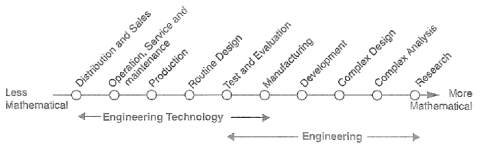
Engineering and engineering technology majors are concerned with the full range of technical issues from design, development and theory through construction and operation. However, the engineering majors place more emphasis on the advanced design, development, technical management and theoretical end of this spectrum; while engineering technology majors focus on the manufacturing, routine design, construction and operation end. Because of this difference the engineering majors requires a significantly higher level of training in mathematics. Purdue Fort Wayne computer engineers majors earn a minor in mathematics automatically. Purdue Fort Wayne civil, electrical, and mechanical engineering majors can earn a minor in mathematics by taking one additional mathematics course.
Engineering and Engineering Technology Careers:
Two Different (But Overlapping) Paths
- Four degree programs: civil engineering, computer engineering, electrical engineering, and mechanical engineering.
- Classes are taught by skilled professors.
- Excellent professor to student ratio. Students enjoy personal attention from faculty.
- Faculty is focused on teaching.
- Active student organizations: ASCE, ASME, IEEE, SAE, and SWE.
- An innovative curriculum that emphasizes design projects “hands-on” laboratory experiences.
- The civil engineering, computer engineering, electrical engineering, and mechanical engineering programs are all accredited by the Engineering Accreditation Commission of ABET.
- Class schedules rotate between day and evening to accommodate working students.
- Co-op and intern programs. Students can earn money and gain valuable experience during their studies.
- PFW engineering graduates are in demand.
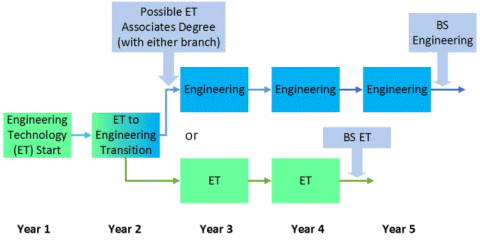
Welcome to Purdue University Fort Wayne’s joint Engineering and Engineering Technology Program. This 2 + 3 program is specifically designed to increase the options and success of students with mathematics placement score of 40, i.e. placement in MA 15300, and who are initially interested in an Engineering degree. Students start with a year of Engineering Technology coursework while they complete the mathematics preparation to start calculus. If they perform well and would like to move to engineering, their second year is a transition to engineering. At the end of this second year it will take three years to graduate in engineering or two years to graduate in Engineering Technology. In many cases students can also complete an associate’s degree in Engineering Technology.
The diagram below shows the required mathematics sequence and an essential physics course to get to sophomore engineering.
INTRODUCTORY MATHEMATICS SEQUENCE FOR JOINT ENGINEERING TECHNOLOGY AND ENGINEERING
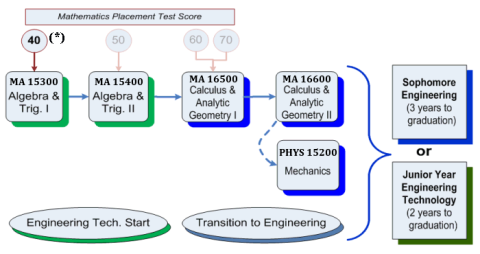
(*) A Math Placement Test Score of 40 means placement in MA 15300.
Engineering is much more than mathematics. However, mathematics is an important tool and successful completion of the initial mathematics sequence is necessary to take most engineering classes. A “C -” or better is required to move on to the next mathematics course in the sequence; a C grade should be a warning that you are likely to have difficulty in the next course.
Students from varied backgrounds and with many different skills can be successful engineers. However, to become an engineer you must have an unusually strong interest and ability in mathematics and science, be able to study efficiently for long hours, and understand what you read. You should be curious about how and why things work. You must also be concerned with the social implications and consequences of everything you do.
In its current rankings of the best colleges and universities in the United States, U.S. News & World Report deemed the engineering programs at Purdue Fort Wayne to be one of the best undergraduate engineering programs in the country (of those that do not offer a doctoral degree).
Visits to Purdue University Fort Wayne are arranged through the Admissions office. Prospective students and parents can directly contact the Department of Electrical and Computer Engineering through email: [email protected] or call 260-481-6032 to arrange for a visit and a tour of the department at a mutually convenient time including evenings and weekends.
The main offices of the ECE Department are located in the Engineering and Technology (ET) building, ET 327.
FIRST-YEAR ENGINEERING
This is the beginning of your success story.
The First-Year Engineering (FYE) Program is dedicated to the success of all students and strives to create a strong bridge from high school to upper-level engineering and beyond. We have a team of dedicated faculty and staff who use a rigorous assessment plan to continue to grow and improve the program each year.
Our goal is to find the right path for each student whether it is within engineering, the College of ETCS, or beyond. Purdue Fort Wayne has many great student success resources to help students with the transition to college, navigate course work, and connect with their future careers. The FYE program highly recommends students utilize these resources early and often.
The College of ETCS Student Success Center organizes many beneficial programs. The Living Learning Community in student housing and the LEAD Peer Mentor program help new students gain valuable mentorship and friendships from other students in their majors. The Help Corner tutoring center provides free tutoring on core engineering classes throughout the school year. For more information about these resources, please visit the Student Success Center.
At Purdue Fort Wayne, all engineering students take a common first-year engineering curriculum. The 30 credits of engineering fundamentals, science, math, composition, and communication lay the foundation for their future engineering majors and careers. Each student’s path through the program may look differently depending on their starting math-level, their incoming credits, and their desired credit-load per semester. Students, under the guidance of their academic advisors, are encouraged to develop a personalized plan towards graduation that meets their individual needs while also adhering to the pre-requisite and co-requisite requirements.
The four-year plan of study for all engineering majors assumes a starting math level of Calculus I (MA 16500) or higher. Students entering the program at a math level of Algebra and Trigonometry II (MA 15400) will need at least 4.5 years to complete the full curriculum. Please see the major specific websites for detailed plans of study and bingo sheets.
All students starting at an Algebra and Trigonometry I (MA 15300) level who would like to pursue a degree in one of the engineering majors will be enrolled in the 2+3 program. The 2+3 program was developed to help students with less math and science experience develop a stronger foundation and build up to their rigorous upper-level engineering classes. Students within the 2+3 program will complete an augmented curriculum that starts with two years of engineering technology (ET) curriculum. Students can then choose to complete the remaining two years of ET curriculum or transition to engineering to complete the remaining three years of engineering courses.
To track your progress toward completing your degree requirements, you can check myBLUEprint. This tool isn’t meant to replace your advisor, so please be sure to meet with them each semester to ensure that you’re track. Access myBLUEprint from the Academic Success tab in goPFW.
Engineering is a rigorous and demanding degree program, but help is never far away. Visit the Student Success Center or the Help Corner whenever you need a little extra help. You’ll also have access to tutoring for any academic area through Purdue Fort Wayne’s tutoring services and testing centers.
In its current rankings of the best colleges and universities in the United States, U.S. News & World Report deemed the engineering programs at Purdue Fort Wayne to be one of the best undergraduate engineering programs in the country (of those that do not offer a doctoral degree).
ECE Academic resources
For undergraduate students.
Where you can find the information of curricula documents for Electrical Engineering and Computer Engineering, one-year ahead ECE Course Schedule and Technical Elective offering schedule, Undergraduate Registration and Advising, Senior Design, and more.
ECE students are strongly encouraged to meet with their assigned academic advisor each semester to review academic progress, discuss course sequencing, and plan upcoming registrations. Academic advising is an important resource to help students remain on track for timely graduation.
Register early. Early registration helps the department plan course offerings and increases the likelihood that students can enroll in required courses. Courses may fill quickly, and students who register late may not be able to enroll in some classes.
Students are responsible for verifying all course co-requisites, prerequisites, and time conflicts. Official requirements should be confirmed using the ECE bingo sheets and the Purdue Fort Wayne Catalog.
- Use the published class schedules and bingo sheets when planning your coursework.
- Students should review their unofficial transcript prior to meeting with their advisor.
- Academic advisors provide guidance on course sequencing, degree requirements, electives, minors, and graduation planning.
- If you believe your academic class standing (freshman, sophomore, junior, or senior) is incorrect, consult your advisor. Academic standing is based on completed credit hours and is separate from progress within the ECE degree program.
- Students planning to graduate must apply for graduation by the published deadlines. Please review the Graduation website for important dates.
- Students pursuing a minor in Mathematics or Physics should consult the respective department websites (Math, Physics) and complete required paperwork on time. Questions regarding minors should be directed to the department offering the minor.
ECE 30200 may be used toward the Mathematics minor. After completing ECE 30200, contact the Math Department to request a MyBluePrint exception.
ECE 22900 and ECE 36800 may be applied toward a Computer Science minor. After completing both courses, contact the Computer Science Department to request approval. - If you experience difficulties or have questions regarding registration, please contact your academic advisor.
Important Note:
Academic standing is determined solely by the number of completed credit hours and is independent of progress within the ECE curriculum.
Only applicable courses listed on the ECE bingo sheet and appearing on the official university transcript are used to determine program standing:
- 90 credits = Senior (students admitted before Fall 2023)
- 90 credits, including ECE 36200 = Senior (students admitted Fall 2023 or later)
- 60 credits = Junior
- 30 credits, including PHYS 15200 = Sophomore
Initial Admission Advising and Four-Year Planning
When students are initially admitted to the ECE program, their assigned academic advisor works closely with them to draft a recommended four-year plan of study. This plan is documented in MyBluePrint and serves as a general roadmap for degree completion.
The four-year plan is a planning tool and may be adjusted over time based on student progress, course performance, scheduling constraints, transfer credit, internships, co-op experiences, or changes in course availability. Students are encouraged to revisit and update their plan with their advisor as needed to ensure continued progress toward graduation.
Submitting a Project Proposal
If your company is interested in sponsoring a senior design project, please fill this form and email it to Dr. Guoping Wang. Please read through this document when considering to sponsor a senior design project. Should you have questions or concerns in the meantime, feel free to contact the Department of Electrical and Computer Engineering Chair, Dr. Guoping Wang. Students need to sign a non-disclosure agreement and transfer of IP rights form. Please contact Director of Engagement, Sean Ryan for any legal questions.
Students eligible to enroll in ece40500 - sdi
As stated in the catalog, only students of senior standing in the program (number of credit hours >=90 including ECE 36200 for students who are admitted in fall 2023 on the bingo sheet of BSEE or BSCPE) can enroll in ECE 40500. After your one-year study of plan is approved by the academic advisor, please contact the department secretary for help with the registration of ECE 40500.
List of Current/Past Senior Design Projects
Prospective and current students please review M.S.E. Program Guidelines.
Each semester, MSE students are strongly encouraged to consult with their academic advisors regarding the courses they plan to take before registering. These discussions help ensure appropriate course selection and steady progress toward the student’s approved plan of study.
While formal registration holds are no longer used for this purpose, students remain responsible for verifying prerequisite requirements, degree progress, and course availability prior to registration.
Note:
- It is the student’s responsibility to check course offerings, co/prerequisite requirements, and time conflicts.
- If you are planning to graduate in the coming semester, please make sure that the plan of study is filed and approved online before the start of the semester and graduation application is done before the deadline.
Preparing Plan of Study
All Master’s students are advised to file a draft of plan of study early in their program. If necessary, changes can be made to the plan of study at a later date. The plan of study must be appropriate to meet the needs of the student’s chosen area of concentration as determined by the advisory committee. The plan of study must be approved latest before the start of the graduating semester.
For instructions to file the Plan of Study, please refer to ECE MSE Guideline
Limited graduate teaching assistantships may be available for MSE students. Please contact the department if you are interested.
If you wish to take an engineering graduate level course without enrolling in the degree program please list your educational goal as non-degree while applying.
MSE students at Purdue Fort Wayne campus are able to take online courses from Purdue West Lafayette campus and count those courses towards their plan of study. Please contact Purdue EPE office using general email address [email protected] if you have any questions.
If you have general questions about the M.S.E graduate program, M.S.E Degree in Computer Engineering, or M.S.E Degree in Electrical Engineering, feel free to contact Director of the Department of Electrical and Computer Engineering Graduate Program, Dr. Chao Chen.
If you have questions about M.S.E Degree in Systems Engineering please contact Dr. David Cochran.
Faculty Office Hours
Faculty Office Hours
Need to contact a faculty member? Looking for the best time to drop by their office? Check out the ECE faculty office hours chart.
SCHOLARSHIPS
Make your degree more affordable.
Who doesn’t like free money? Well, you’re leaving a lot on the table if you don’t check out the various scholarships and awards that are available. See what you may qualify for today.
ETCS SCHOLARSHIPS FOR CURRENT ECE STUDENTS
- BAE Scholarship
- Lam Memorial Scholarship
- Molfenter Scholarship
- Robert J. Thompson Endowed Scholarship
- Steeg Engineering Scholarship
- Larry Graham Scholarship
- Carlos Pomalaza Raez Memorial Endowed Scholarship
- ETCS Engineering & Technology Scholarship
- Questa Foundation Scholarship Students who are interested in receiving funding will apply through the Questa Contemporary Scholars program. Students can receive up to $5,000 each academic year to support cost of attendance and will receive 75% forgiveness when they graduate and live/work in NE Indiana for 5 years after degree completion.
If you have been academically dropped from Purdue Fort Wayne and wish to reapply, you should review the following information carefully. This material will help you understand the readmission process and requirements to get you back on track to Purdue Fort Wayne.
Readmission to the electrical engineering or computer engineering program is not automatic or guaranteed, and it’s your responsibility to understand and complete all the steps in the readmission process.
There is no appeal process for academic dismissal. Make sure that all your assigned grades are accurate. If a grade is changed because of a reporting error, your GPA will be recalculated, which may affect the drop decision.
You may be eligible for an exception if
- you have 15 or fewer credit hours to complete your degree and can take all your remaining courses in a single semester, and
- there are extenuating circumstances beyond your control, such as serious health issues.
A student is allowed to attempt ENGR 12700 Engineering Fundamentals I and ENGR 12800 Engineering Fundamentals II only three times, each. This includes all attempts that have earned a withdrawal, letter grade, or pass/no pass. If a student fails to earn a successful grade (C– or higher or pass) after three attempts in either course, the student is removed from the mechanical, civil, electrical, and computer engineering programs at Purdue University Fort Wayne and is not eligible for reentry.
Academic Resources
The support you need.
Your education is not a singular pursuit, and we recognize that. You’ll have plenty of support from the Mastodon community.