
Teaching Development Grants & Awards
Center for the enhancement of learning and teaching
CELT Teaching Development Grants
The Course Design and Teaching Development grant programs are funded by Academic Affairs and administered through the Center for Enhancement of Learning and Teaching (CELT). These funds support the professional development of PFW faculty, helping to improve their teaching skills, knowledge, and effectiveness. The grants can be used for attending conferences, workshops, conducting research, or developing new teaching materials. For more information or to apply for next year’s grants, please contact us at [email protected].

2025-2026 CELT Teaching Development Grants
Please explore the following grant types that are available.
CELT leadership will guide 10 faculty (about one or two faculty per college or school) as they identify discipline-relevant AI tools while testing their capabilities, limitations, and proposing best practices for classroom integration. Collectively, the group will develop a campus-wide resource bank that outlines the AI tools they incorporated, the tools, their capabilities, costs, and more.
Course design (or redesign) is the foundation to pedagogically sound (and satisfying) teaching. This programming targets newer faculty to support them in an effective start to their teaching careers, through the backward course design model. Topics revolve around building a pedagogically sound course structure, including designing course learning goals, learning objectives, designing and aligning assessments, developing and aligning learning activities and interaction design, weekly structure and syllabus design, and studying effective communication with and support for students, including identifying and supporting struggling students. Applications for all teaching modalities (i.e. face to face, hybrid, online) are welcome.
The Scholarship of Teaching and Learning cohort is a two-year program that provides structured support for post-promotion faculty to complete a robust research project focused on teaching and learning. Participants will complete workshops, project development sessions, and independent activities that guide them through a research project, culminating in a conference proposal and manuscript. Program topics will include an overview of SoTL, refining research topics/questions, reviewing the SoTL literature, study design, data collection and instruments, IRB approval, planning for publication and presentation, data analysis, and data management.
The primary goal of the Student as Partner programs is to create a collaborative teaching environment where students and faculty work together to enhance learning through shared insights, co-creation, and mutual reflection. This is done by fostering collaborative, semester-long partnerships between an instructor and a student who has successfully completed the course being considered. Embedded in the classroom, student partners co-create meaningful teaching and learning experiences, provide real-time feedback, and help implement high-impact pedagogical strategies. This approach emphasizes open communication, reduces power dynamics, and recognizes students as essential contributors to course design, engagement, and assessment—ultimately strengthening the student-instructor relationship.
Summative Peer Reviews are a meaningful part of faculty development and evaluation, yet require a unique skillset for effective delivery. This cohort-style program is designed to help faculty hone their skills in conducting summative peer reviews of teaching. The year-long program includes synchronous and asynchronous professional development activities that focus on key topics, including the peer review process, defining criteria for teaching evaluation, crafting effective feedback, and writing peer review letters. Participants will also gain skills for specific peer review activities, like classroom observation, syllabus review, and analysis of student evaluation data.
This grant is a three- to five-year program where associate faculty can further develop skills to help with building a portfolio to demonstrate competence and/or excellence in teaching. Focus areas include:
- Year 1
Course design quality and delivery - Year 2
SoTL knowledge and production - Year 3
PFW student needs and challenges - Years 4 and 5
Becoming a teaching mentor or expanding SoTL expertise and output
Track 1: Learn a variety of teaching strategies, become a teaching mentor
Track 2: Further build SoTL expertise and output (two separate tracks)
Faculty accepted into this program commit to the first three years with a preference to complete all five years. A $2,500 grant is awarded through year 1 of the program. For all faculty who commit to completing years 4 and 5, an additional $2,500 grant is awarded. A brief description of each focus area is below:
Year 1: Course Design Quality and Delivery
Course design (or redesign) is the foundation for pedagogically sound (and satisfying) teaching. This programming guides faculty through the backward course design model. Five 2-hour workshops and a minimum of four one-on-one consultations are required. Topics revolve around building a pedagogically sound course structure, including designing course learning goals, learning objectives, designing and aligning assessments, developing and aligning learning activities and interaction design, weekly structure and syllabus design, and studying effective communication with and support for students including identifying and supporting struggling students.
Year 2: SoTL Knowledge and Production
Towards the end of year 1 (above) and moving into year 2, similar to identifying a program of research, participants will choose a program of SoTL, which will guide their work for the next 2–4 years. This year’s cohort provides post-tenure faculty with structured support to design and implement a teaching-related research project. The year-long program consists of five required group workshops and a minimum of five individualized consultations. Topics include an overview of SoTL, refining topic/question, literature review, study design, data collection & instruments, IRB, planning for publication and presentation, data analysis, and data management.
Year 3: PFW Student Needs and Challenges
Participant’s SoTL program continues in Year 3, which will be a focused cohort giving specific attention to the student-instructor classroom exchange. It will blend the continued development of pedagogy and instruction with a deep understanding of PFW’s student body, their needs, strengths, and challenges. The program consists of eight required group workshops and a minimum of five individualized consultations. Topics and activities include research focused on student learning, connection, and development; developing mechanisms for understanding the needs of our students; work with a CELT Teaching Fellow including a SGID or Faculty observation; and an Online Course Design Review or syllabus and assignment review. This year will also provide a unique opportunity for participants to work with student consultants, who will observe and provide comprehensive feedback to faculty regarding teaching methodologies, student relationships, the use of Brightspace, and grading practices.
Year 4 and 5: Becoming a Teaching Mentor or Expanding SoTL expertise and Output
During years 4 and 5 faculty will need to choose a track to pursue. This can include:
Track 1: Becoming a Teaching Mentor
High and Small Impact Practices (Year 4) will be a focused cohort giving post-promotion faculty-specific instruction in the development and comprehensive implementation of a High Impact (teaching) Practice (HIP). This will span both Fall and Spring semesters and focus on three key areas:
- Participants will choose a HIP and comprehensively integrate it into a course. The HIP will seek to address a student or course “problem” using the knowledge and application of a HIP. Faculty will develop an assessment plan for understanding the impact of the HIP.
- Faculty will be consulted in the development phase by a student review panel, a faculty mentor who has substantial experience with their chosen HIP, peer review, and the CELT consultant leading the cohort.
- Faculty will assess the effectiveness of the implementation of the HIP while teaching the course through a pre-test, mid-semester test, Small Group Instructional Diagnosis (SGID), and a post-test.
Becoming a Teaching Mentor (Year 5 of High and Small Impact Practices track)
We would like to use this program to train faculty to become Peer Reviewers in CELT and for the campus. This will help to better support our existing review Fellows program while growing the number of trained faculty who are prepared to conduct summative reviews.
Track 2: Expanding SoTL expertise and Output
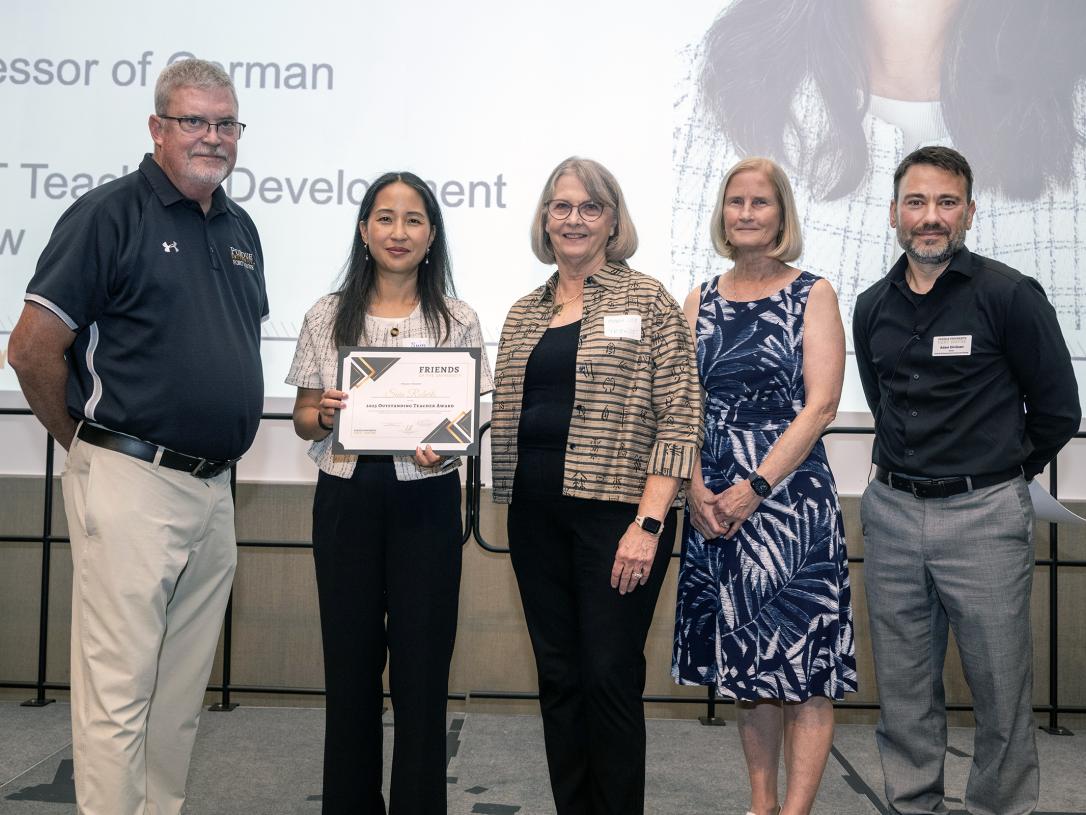
2025-2026 CELT Awards
Teaching awards are offered each spring term and are open to Purdue Fort Wayne faculty. Applications are due by the Monday following spring break. View the nomination guidelines for specific details regarding eligibility.
The purpose of the Excellence in Online or Hybrid Teaching Award is to recognize an individual whose online and/or hybrid teaching has consistently and measurably enhanced student learning.
Nomination Guidelines and Application
Previous Winners
2024 Brad Oliver, EDU
2023 Teri Hogg, EDU
2022 Nan Suntornpithug, BUS
2021 Tanya Soule, BIOL
2020 Jeff Nowak, EDU
2019 Rama Cousik, EDU
2019 Naomi Gurevich, CSD
2016 Joy Musser, CSD
2016 John LaMaster, MATH
2015 Heather Krull, NURS
2014 Worth Weller, ENG
2013 Kent Kauffman, BUS
2012 Michelle Drouin, PSY
2012 Ken Johnson, MUS
2011 Matt Kubik, MCET
2010 Adam Dircksen, COM
The purpose of the award is to honor a faculty member for outstanding performance in the area of teaching. The faculty member so honored will have demonstrated exceptional ability in communicating and stimulating students’ desire to learn in the classroom, on the campus, and in the community.
Nomination Guidelines and Application
Previous Winners
2024 Carolyn Stumph, ECON
2023 Rebecca Essig, ENGR
2022 Luke Rodesiler, EDUC
2021 Jeffrey Casazza, THTR
2019 Jane Leatherman, EDUC
2018 Michelle Drouin, PSY
2017 Betsy Berry, MATH
2016 Jeong-il Cho, EDUC
2014 Ahmed Mustafa, BIOL
2013 Stella Batagiannis, EDUC
2012 Linda Wright-Bower, MUS
2011 Kathy Pollock, ACFN
2010 Mary Cooper, DENT
2009 Jeffrey Nowak, EDUC
2008 Mark Masters, PHYS
2007 Marcia Dixson, COM
2006 Lucille Hess, AUS
2005 Linda Lolkus, CFS
2004 John LaMaster, MATH
2003 Elliott Blumenthal, BIOL
2002 Lesa Rae Vartanian, PSY
2001 Pat Ashton, SOCA
2000 David May, SPEA
1999 AnnMarie LeBlanc, VPA
1998 David Young, PSY
1997 Yvonne Zubovic, MA
1996 Linda Fox, MFL
1995 Dipak Chowdhury, GEOS
1994 Lowell Madden, EDUC
1993 Joseph Meyers, MUS
1992 Lowell Beineke, MA
1991 Dyne Pfeffenberger, ACFN
1990 Hermine Van Nuis, ENG
1989 James Hersberger, MA
1988 Arthur Friedel, CHM
1987 Mary Helen Thuente, ENG
1986 Stephen Harroff, MFL
1985 Anthony Loviscek
1984 Fred Jehle, MFL
1983 Richard Pacer, CHM
1982 Robert Barrett, CS
1981 Rudy Svoboda, MA
1980 Joseph Chandler, SPV
1979 Richard Wall, MFL
This award will benefit faculty at Purdue University Fort Wayne who demonstrate excellence in undergraduate teaching. The accomplishment can result from a single activity, project or course to encourage innovative teaching and learning experiences.
Previous Winners
2024 Hanan Alyami, EDU
2023 John Egger, MUS
2022 Mary Encabo-Bischoff, ENGL
2021 Scott Bergeson, BIOL
2020 Linda Wark, HSRV
2019 Lucas Rodesiler,EDU
2018 Linda Wright-Bower, MUS
2017 John LaMaster, MATH
2016 Damian Fleming, ENGL
2015 Mark Jordan, BIOL
2014 Yuriko Ujike, ILCS
2013 Jeff Casazza, THTR
2012 Il-Hee Kim, EDUC
2011 Nichaya "Nan" Suntornpithug, MGMK
2010 Sharon Egly, AUS
2009 Michael Columbia, CHM
2008 Nancy Virtue, ILCS
2007 Jeffrey Nowak, EDUC
2006 Hedayeh Samavati, ECON
2005 Kathy Pollock, ACFN
FACET is an Indiana University Presidential Initiative to promote and sustain teaching excellence. Each year, approximately 20–25 candidates from across the IU campuses, including Purdue Fort Wayne, are selected as new members.
Contact Us
Have questions?
Contact us at [email protected] or 260-481-6354.
You can also find us on campus in Kettler Hall, Room 238.