
Purdue Fort Wayne UNESCO Chair
UNESCo
About UNESCO
UNESCO, the United Nations Education, Scientific, and Cultural Organization, is a network that brings together academic and research institutions that are leading efforts to address global challenges through education, the sciences, culture, and communication.
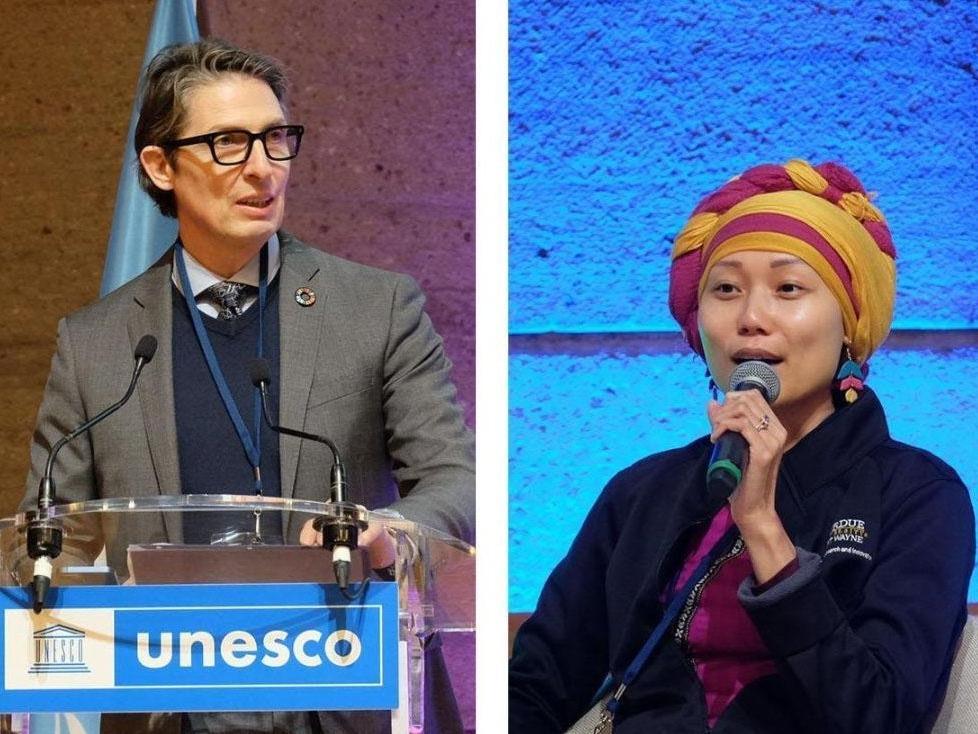

Rights Education Among Indigenous and Nondominant Language Communities
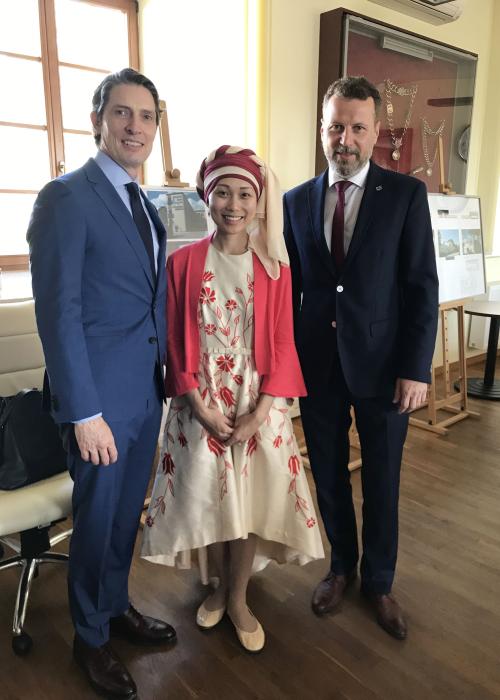
Shannon Bischoff, chair of the Department of Communication Sciences and Disorders, and Mary Encabo Bischoff, director of the Teaching English as a New Language program, were awarded a UNESCO Chair—making Purdue University Fort Wayne one of the more than 1,000 participating institutions.
Bischoff and Encabo Bischoff share the role of UNESCO Chair on Rights Education among Indigenous and Nondominant Language Communities with colleague, Candace K. Galla—an associate professor of Indigenous language and literacy at the University of British Columbia in Vancouver
Key objectives and programs of the chair:
Indigenous Language Rights & Realities (ILR&R)
Open-access, community-rooted publishing written by indigenous and non-dominant community scholars and practitioners.
Massive Open Online Course (MOOC): Indigenous Languages:
From Policy and Planning to Implementation and Assessment: Learners from over 90 countries learn about and participate in dialogue on language policy, revitalization, and the right to learn and teach in one’s own language.
English Language Partners Program:
Purdue Fort Wayne students work with multilingual learners from around the world to deliver culturally responsive English language classes that aim to sustain learners’ linguistic and cultural identities, despite being displaced by conflict or colonization.
Capacity Building and Educational Training Network:
We collaborate with Indigenous and ethnic higher-education institutions across Southeast Asia and Latin America to strengthen pedagogical innovation, curriculum design, and digital inclusion.
Purdue Fort Wayne Unesco Chairs

Shannon Bischoff
Chair of Communication Sciences & Disorders, Professor of Linguistics
[email protected]
Dr. Shannon Bischoff completed a double major in Anthropology and Linguistics for his PhD work at the University of Arizona, with a minor in computational linguistics. He was a research fellow at the University of Tokyo and has conducted post-graduate work at the University of Pennsylvania. His research encompasses computational linguistics, formal linguistics, language documentation and conservation, language rights and human rights, pedagogical linguistics, and linguistic anthropology. He has secured over $2 million in funding for his work, including seven National Science Foundation grants, one National Endowment for the Humanities grant, and two grants from the Japanese Society for the Promotion of Science. His work has been cited in The Oxford Research Encyclopedia of Linguistics, The Oxford Handbook of Language Attrition, the Routledge Handbook of Linguistics, the Routledge Handbook of Syntax, The Routledge Handbook of Linguistic Anthropology, The Languages and Linguistics of North America, Second Language Learning Theories, and the Handbook of Research Ethics and Scientific Integrity, among others. Dr. Bischoff's publications span a number of presses including Oxford University Press, MIT Press, and De Gruyter Mouton, as well as Q1 journals. He has presented as an invited speaker at the United Nations, UNESCO, the British Council, and Cambridge University, among others. He is a member of several scholarly societies including the Comparative & International Education Society, the Linguistic Society of America, the Society for the Study of Indigenous Languages of the Americas, and the American Academy for the Advancement of Science. He has received awards for his teaching and research, including nominations for the Franz Boas Prize and winning the Ken Hale Prize with his research team in 2018. Dr. Bischoff is actively involved in UNESCO's International Decade of Indigenous Languages initiatives and has taught at institutions such as the American Indian Language Development Institute and The Institute on Collaborative Language Research.

Mary Encabo Bischoff
Clinical Assistant Professor of Linguistics
[email protected]
Mary Encabo Bischoff is a Clinical Assistant Professor of Linguistics and Director of the Teaching English as a New Language program at Purdue University Fort Wayne. She graduated summa cum laude from Bryn Mawr College and completed her M.S.Ed in International Educational Development at the University of Pennsylvania. Her research interests include teacher education and professional development, TESOL, international educational policy, and curriculum and pedagogy in Southeast Asia. During her time at Penn, she also worked on projects related to educational entrepreneurship and non-profit/NGO management. At Purdue Fort Wayne, she not only teaches college students, but also works with teachers of English as a Second and Foreign language and directs the English Language Partners (ELP) Program, which has served over 1,500 individuals, including indigenous communities, from Myanmar, Thailand, Nepal, the Philippines, Ecuador, India, Japan, and the list continues to grow. She previously served on the board of Fort Wayne Sister Cities, which led to exchanges and partnerships with universities and high schools in Myanmar and Japan.
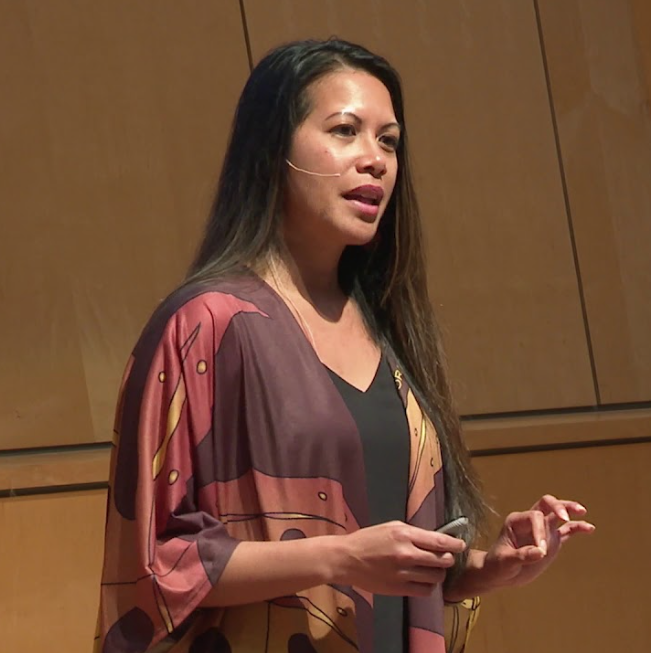
Candace Kaleimamoowahinekapu Galla was born and raised on the island of Hawaiʻi in Pāhala, Kaʻū . At home, she was immersed in Hawaiian culture and hula (Hawaiian traditional dance); taught by her Native Hawaiian and Filipino kumu hula (hula master) mother. From her Filipino father, she developed a deep connection to the ocean and was taught to appreciate, respect, and embrace the ocean. She learned ʻŌlelo Hawaiʻi formally at a time when there was an ideology that “learning and/or speaking Hawaiian would not be relevant in the ‘real-world’”. At the University of Arizona, she received her B.A. in Linguistics, M.A. in Native American Linguistics, and Ph.D. in Language, Reading, & Culture. During her time as the Program Coordinator of the American Indian Language Development Institute (AILDI), her passion was reignited back into her Hawaiian culture which inspired her dissertation research on Indigenous language revitalization and technology. Upon moving back to Hawaiʻi, Candace worked as a Visiting Assistant Professor in Ka Haka ʻUla O Keʻelikōlani College of Hawaiian Language at the University of Hawaiʻi in Hilo. She now resides in Vancouver, as an Associate Professor at the University of British Columbia in the Institute for Critical Indigenous Studies (Faculty of Arts) and the Department of Language and Literacy Education (Faculty of Education). Her research and scholarship focus on Hawaiian language and Indigenous languages at the intersection of education, revitalization, digital technology, well-being, traditional and cultural practices, and policy and planning; and decolonizing and Indigenizing the academy to create pathways for Indigenous thinkers and scholars, and scholarship – locally, nationally, and globally.

Three Rivers Language Center
Language matters.
The Three Rivers Language Center serves nondominant language communities in their efforts to pursue linguistic rights and the use of their languages. Our team comprises Purdue Fort Wayne faculty and fellows who work on research and outreach projects worldwide, spanning research, education, training, and policy development, as well as advising governments, nongovernmental organizations, and civil society groups.
