
Digital Strategy
Marketing Services
Powering Smarter Digital Solutions
The digital strategy team provides essential resources and expert guidance to optimize the university's digital landscape, including web development, content management, and user accessibility. Our efforts ensure that digital platforms are not only visually appealing and easy to navigate but also compliant with the latest standards and best practices—always prioritizing the user experience.
Strategy and Analytics
Leveraging data for informed strategies.
The digital strategy team gleans insights from Google Analytics 360 to shape digital-first strategies. We strive to optimize every facet of user interaction from experience design to digital content. Our analytics-driven approach ensures that strategic decisions are aligned with user behaviors and preferences, supporting engagement and effectiveness across key digital platforms.
The digital strategy team strives to stay apace with the ever-evolving digital landscape. Our digital-first philosophy prioritizes online channels and technology experiences, helping the university fully engage with its audiences wherever they are. The team focuses on websites, digital displays, electronic newsletter design, and other digital spaces to meet the expectations of our key audiences. We leverage analytics to inform better decision-making when designing and building online content. By prioritizing digital channels, we ensure that user experiences offer not only convenience and personalization but also optimized and effective online engagement.
User experience (UX) design is at the heart of our digital-first approach. It lies at the crux of digital spaces and satisfying user experiences. It spans all aspects of a user's interaction with the university's primary digital platforms, aiming to create seamless, intuitive, and engaging experiences. Our focus on UX design ensures that digital offerings function delightfully, ultimately boosting user retention and loyalty. We craft UX designs that enhance the effectiveness of digital content and use analytics to improve digital spaces, ensuring they foster genuine audience interest and engagement. Our focus on user-centered design transforms passive prospects into engaged participants, promoting deeper connections between digital spaces and the overall university experience.
The digital strategy team supports broader university initiatives by making strategy central to the creation, management, and distribution of content across online channels. We strive to develop digital content that resonates with the university's target audiences and optimizes each piece for engagement, searchability, and user satisfaction. We ensure that content aligns with insights from user metrics to increase visibility and reach, strengthen the university's substantial brand presence, and promote audience engagement and conversions.
Our access to Google Analytics 360 allows us to leverage advanced analytics for optimizing the Purdue University Fort Wayne website. We can gather, analyze, and act upon comprehensive data regarding user behaviors, preferences, and engagement. This allows us to make informed decisions regarding user experience design and content strategy. We can thus ensure that the university's digital offerings effectively meet the needs and expectations of students, faculty, and prospects. Google Analytics 360 enables us to optimize digital initiatives and ensure they align with university objectives.
Digital Design and Development
The user experience comes first.
The digital strategy team prioritizes user experience above all in designing and developing the university's website and other digital spaces. We strive to ensure that digital channels provide both pleasing aesthetics and seamless interactions for students, faculty, and visitors. We continuously monitor real-time data and feedback and iterate on online environments and functionality to optimize usability and engagement for all users.
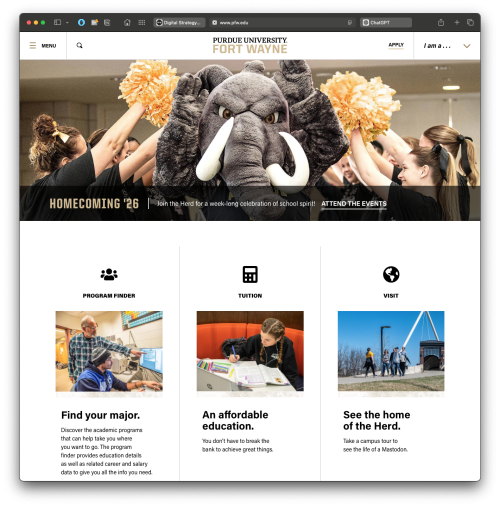
The Office of Strategic Communications oversees the university's website, which serves as the central hub for digital engagement and the primary portal for prospective and current students, faculty, alumni, and visitors to access essential information and services. It provides resources ranging from academic programs and activities to student services, campus news, and events, allowing everyone to stay informed and connected with the university's offerings. The website supports academic and administrative functions while conveying the university’s brand and values online. Its ultimate purpose is to enhance user engagement and reinforce the university’s reputation as a digitally savvy institution.
We employ a tailored approach to building websites for the university’s hundreds of administrative and academic units. We ensure that each site meets the department's specific needs while maintaining a cohesive look and feel that aligns with university branding. We collaborate with each department to understand its goals and objectives, and implement best practices in UX design and content strategy to enhance accessibility, searchability, navigation, and user engagement. Our process ensures that each department's website is robust and effective, providing a seamless user experience that supports the unit's operational and strategic goals.
After the university homepage, the academic program finder receives more visits than any other area of the website. This crucial web application serves prospective and current students, as well as their families, by simplifying the search for academic programs that align with their educational and career aspirations. The academic program finder offers a user-friendly and accessible interface that enables students to explore and compare the nearly 200 majors and minors available at the university. By empowering students to quickly find relevant program and career information, the academic program finder enhances their educational discovery and decision-making, thereby supporting the university’s goals of increasing enrollment and retention rates.
The News Center plays a vital role in our digital engagement strategy by serving as the central location for broadcasting the latest developments, achievements, and events of the university. Administered by the University Communications team, this area of the website is crucial for keeping all stakeholders—students, faculty, staff, alumni, and the broader community—informed and engaged with the university's ongoing news. By delivering timely and relevant news, the News Center bolsters the university's image and outreach, promoting a positive public perception and supporting the institution’s broader communication strategies.
The events calendar is crucial in promoting the university's numerous events and activities, both on the calendar itself and on departmental websites. As the central events hub, it is designed to boost awareness and attendance among students, faculty, and the broader community. It enhances the university experience by encouraging active participation, promoting events, and facilitating planning. The effective use of the events calendar by units across campus supports university engagement. It also showcases the vibrancy of campus life to prospective and current students, as well as external audiences.
The people directory is a valuable resource that enhances connectivity and collaboration for university stakeholders. Updated weekly on the website, the data is maintained jointly by the Office of Strategic Communications, Human Resources, and Purdue Information Technology. The directory ensures that contact information for faculty, staff, and student employees (contact information, job title, department affiliation, and optional photograph) is accurate, up-to-date, and easily accessible centrally and across department websites. This centralized information source enables students, faculty, and staff to quickly locate and connect with relevant individuals across the university, streamlining internal communication and fostering academic and professional collaboration, thereby significantly improving organizational efficiency.
Maintained by the Office of Strategic Communications, the website's A–Z index greatly enhances the user experience by providing a straightforward, alphabetical listing of university departments, offices, services, and resources. This feature enables site visitors to access specific pages without navigating multiple menus or using search engines. It also allows users to see which social media are sponsored by various university departments. By offering a direct route to information, the A–Z index simplifies website exploration, particularly for new users or external visitors unfamiliar with the university's organizational structure. It significantly improves browsing efficiency and helps reduce the time and effort required to locate relevant information.
The Native Trees of Indiana Riverwalk section on the university's website provides significant educational and environmental value, showcasing a diverse array of indigenous tree species along a dedicated pathway accessible to visitors and the university community. As an essential educational tool, it enhances biological and environmental studies and conservation efforts within the broader community. By cataloging native trees, flora, and fauna, the riverwalk showcases the university’s commitment to sustainability and biodiversity, providing a serene, natural retreat that promotes the physical and mental well-being of campus visitors. Hosting this resource online extends its reach, allowing virtual visitors to explore and learn about local flora and fauna, thereby boosting the university's outreach and educational impact.
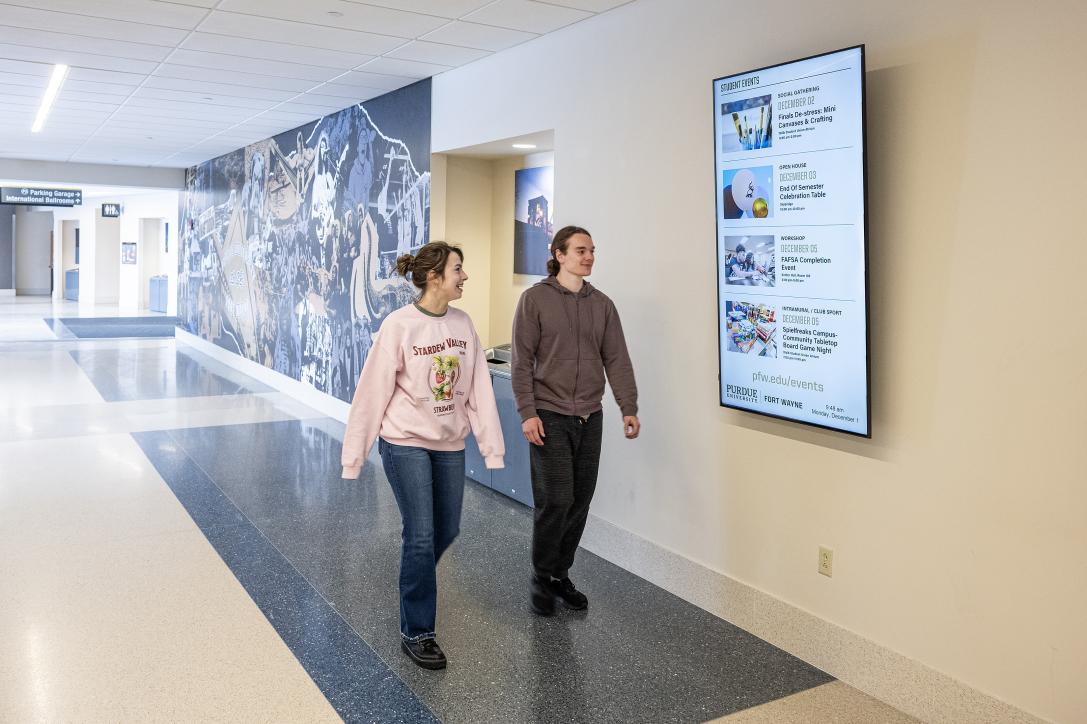
Consisting of more than 100 screens across campus, the university’s digital display network is a powerful strategic communication tool, providing both centralized and decentralized capabilities to enhance information dissemination. Leveraging content from the university's web content management system, Drupal, the Office of Strategic Communications manages centralized communications, ensuring that all displays carry consistent, official messages for events, announcements, and campus safety, while maintaining a consistent university brand. At the same time, individual departments may tailor content to local needs, enabling specific messaging that directly engages their immediate audience. This blend of central and local control makes the digital display network extremely effective for university communications. It also provides immediate, campus-wide alerts that ensure safety and keep the university community informed and prepared.
The digital strategy team plays a crucial role in supporting the Office of Strategic Communications by providing expert design and template development for centralized university communications. We focus on crafting templates that visually engage and align with the university’s branding guidelines. The templates are designed to be user-friendly and adaptable, allowing communicators within the Office of Strategic Communications to easily insert relevant text, images, and links without requiring extensive technical skills. This support streamlines the creation of regular and special newsletters, announcements, and other communications, ensuring they effectively reach their intended audiences while maintaining professional standards and cohesive branding.
Web Content Management Systems
Organization and purpose.
The Office of Strategic Communications actively supports Drupal and dotCMS to ensure optimal web content management across university departments. While the office primarily focuses on these CMSs, it also provides essential guidelines and limited support to ensure that university websites hosted outside these systems adhere to the university's branding and communication standards. This strategic support structure ensures consistency and effectiveness across all platforms. Note that the digital strategy team does not provide UX design or development support for university websites hosted outside these two CMSs.
The transition to Acquia-hosted Drupal as the university's content management system (CMS) represents a significant shift in how web content is managed, offering robust benefits and greater ease of use. We chose Drupal because it provides a flexible, scalable architecture well-suited to Purdue University Fort Wayne, allowing us to perform extensive customization and integration that accommodates the varied and complex needs of different departments. We leverage Drupal's robust security features to ensure the university's data and user information are protected against unauthorized access and data breaches. Moreover, we leverage Drupal's extensive community and open-source nature to continuously improve the website, ensuring the university remains at the forefront of web technologies. This transition not only allows the team to operate efficiently but also provides a consistent branding and user experience across the university's digital platforms. We also give campus publishers a stable, secure, and user-friendly environment for content creation and management. The digital strategy team anticipates completing the transition of the university website to Drupal by June 30, 2026.
The university is aggressively phasing out dotCMS in favor of Drupal, completing the transition by June 30, 2026. We have ceased creating new dotCMS sites and are migrating the remaining sites on an accelerated schedule. We will train the remaining university staff on Drupal’s functionality to ensure a smooth transition for the affected departments by June 30.

Web Content Personalization
Made for you.
The digital strategy team utilizes Acquia Convert to deliver personalized web content in Drupal. We provide tailored experiences that resonate with individual user preferences and behaviors. This focused personalization not only maximizes user engagement and satisfaction by presenting the most relevant content but also improves conversion rates and strengthens the university's overall content strategy.
Web Content Accessibility
Our commitment to content for all.
As part of Purdue University policy, the Office of Strategic Communications prioritizes web content accessibility by adhering to web accessibility standards. Our goal is to deliver digital and web resources that are accessible to all users, including those with disabilities. Users are encouraged to report any accessibility issues to the Office of Civil Rights Compliance using the Accessibility Concerns Notification form, facilitating the university's continuous improvement and compliance with accessibility standards.
The digital strategy team is rigorously applying the Web Content Accessibility Guidelines (WCAG) 2.1, Level AA, as the standard for designing and developing websites within the university's content management systems. These standards go into effect on April 24, 2026. By doing so, we strive to ensure that web content is accessible to users with disabilities. This adherence involves implementing specific technical and design criteria, such as providing text alternatives for non-text content, ensuring keyboard-accessible navigation, and ensuring sufficient color contrast. These continuous improvement efforts aim to enable everyone, regardless of ability, to interact effectively with and benefit from the university's website. Overall, these practices enhance the user experience for a broader audience.
The digital strategy team uses Siteimprove (administered by Purdue University West Lafayette), along with other analytic and optimization tools, to assess and enhance website accessibility, search engine optimization (SEO), and overall user experience. The team uses automated audits and reports to pinpoint accessibility issues, SEO best-practice adherence, and usability flaws across the university's website. These insights enable the team to make data-driven adjustments, ensuring continuous improvements toward compliance with accessibility standards, specifically the WCAG 2.1 Level AA technical standards, as well as maximizing user engagement and search engine visibility.
By spring 2026, the digital strategy team plans to raise awareness about, enhance support for, and offer supplemental training focused on accessibility in Drupal. This initiative will include hands-on Teams workshops, detailed online guidelines, and ongoing office hours to help Drupal publishers create and maintain content that meets accessibility standards. The support and training will aim to empower content creators with the knowledge and skills needed to produce content accessible to a diverse audience, thereby improving the usability of the university’s website. Through these efforts, the team will raise awareness of Drupal publishers' responsibility and role in publishing content that complies with these essential standards.

Shortened urls and domains
Keeping it brief.
We promote the use of vanity or shortened URLs to simplify sharing and make web addresses easier to communicate. Please don't hesitate to contact us if you need a vanity URL. Note that the Office of Strategic Communications can no longer support domains or subdomains using either Drupal or dotCMS. This approach aims to improve the user experience by organizing content under a primary domain.
Digital Display Network
A bold, unified look to our digital screens.
The Office of Strategic Communications promotes a consistent visual and informational presentation across all campus digital displays. We provide essential resources, including design templates and content management guidelines, to maintain consistency and enhance communication effectiveness across the Digital Display Network.
The Office of Strategic Communications administers Yodeck to manage the university's Digital Display Network, maximizing the visibility and effectiveness of the campus's strategic communications. With this platform, the team can streamline the scheduling and broadcasting of branded content across nearly 100 campus screens, ensuring timely and consistent updates. Our adoption of Yodeck provides campus units with an intuitive interface that reduces technical barriers, enabling the easy creation of branded and engaging content that enhances student engagement and campus communication. Publishers not only save time but are empowered to deliver critical messages and announcements.
We provide comprehensive training and support designed to empower departments to create and manage their digital content effectively at the local level. These resources include online training sessions, detailed guides, and ongoing technical support, which equip department staff with the skills needed to use Yodeck efficiently. This support enables each department to create and promote its specific content, thereby enhancing visibility and engagement within its targeted community.
University offices and departments are expected to be diligent stewards of the Digital Display Network, adhering to established training guidelines and the terms of the Service Level Agreement (SLA). This responsibility ensures that they use the network efficiently and responsibly, maintaining the integrity of the university's brand and communications standards. Following these guidelines and agreements facilitates smooth operations and a consistent digital experience for visitors across the campus. This adherence is crucial for maintaining the effectiveness and fairness of the support and services provided, ultimately contributing to the overall success of the university's Digital Display Network.

Training and Support
Training and Support
We provide targeted support and training across campus to enhance proficiency with Drupal, Yodeck, and web content accessibility. These educational initiatives are designed to empower the university community by ensuring they have the tools and knowledge needed to manage and deliver digital content effectively.
Have a question or concern? Looking to collaborate? Reach out to the Marketing Services team through our request form to get the answers and resources you need.