While continuing to teach, provost receives prestigious honor
By Blake Sebring
March 4, 2026
No one on the Purdue University Fort Wayne campus has a better excuse to play hooky and miss a class than Carl Drummond, the provost and vice chancellor for academic affairs. He’s always busy, even making work calls on his long drives to and from campus, or answering at home whenever the chancellor needs him.
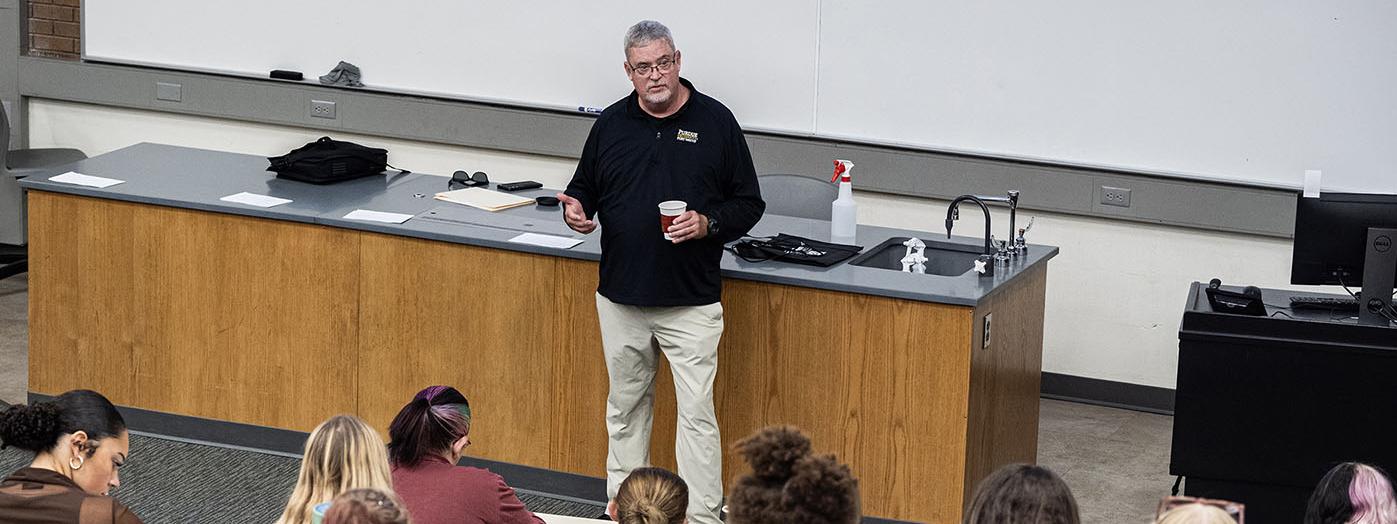
But since the spring of 2021, Drummond has also taught a class each fall semester, usually an introductory physical geography course, with more than 100 students and covering a variety of earth-focused topics. Drummond estimates that 70% of the students are freshmen majoring in elementary education or early childhood development.
There are reasons why Drummond thinks his teaching is important.
“One is it’s a connection to the modern students,” he said. “I hear them, I watch them interact before class, and I get a better sense of who our students are. It’s a good experience for me.”
Another helps his position as a member of the chancellor’s cabinet since 2014. Before that, Drummond served as dean of the College of Arts and Sciences from 2009 to 2014 and as vice chancellor for research and external support from 2002 to 2009.
“I think it’s really essential that I model good faculty behavior, and so taking on this class and making that contribution is important so I have some credibility and ability to speak with some authority when I’m talking to my colleagues,” Drummond said. “When I have to do things like ask to raise the enrollment caps for some of our classes, I can do that with some credibility.”
As Drummond said, he sees himself as a teacher more than as an administrator. It inspires and fulfills him. His email signature lists him first as a professor of Earth and planetary science and second as provost and vice chancellor.
Becoming provost was simply something that happened along the way, Drummond said, and he plans to return to a full-time teaching position at some point because he loves teaching so much.
How much? At the tail end of the COVID outbreak, after Drummond wrote 17 policy and procedural documents, he volunteered to teach a class during the spring 2021 semester. Some students needed the mineralogy class to fulfill requirements, even though Drummond had never taught it before.
Even that class inspired him, leading to ideas that became three research papers. Drummond realized he was missing something important, so he returned to writing papers. Since 2021, he has added nine to his 31 total scientific publications, along with four academic administration publications, nine essays, and 24 academic editorials.
Researching and writing are more than a hobby for Drummond, who also loves woodworking, but also recharge him. Once he starts a paper, the goal is to write 2–4 paragraphs a day while also editing previous work. That process includes sitting on the sofa with pen and paper, writing longhand.
“I really love the process,” Drummond said. “Over the course of several months, pretty soon you’ll have a paper.”
His papers are both successful and respected. On May 7, Drummond was notified of his election as a fellow of the Geological Society of London, founded in 1807 as the first learned society dedicated to the geological sciences.
A member of the PFW faculty for 31 years, Drummond was elected a fellow of the Geological Society of America in 2000 after being named a recipient of the James Lee Wilson Award for outstanding achievement in sedimentary geology by a young scientist by the Society for Sedimentary Geology in 1998.
Drummond also served as editor of the Journal of Geoscience Education from 1999 to 2008.
It's all part of his CV, but at heart, Drummond will always identify as a teacher first.
“It’s really great to be a member of the faculty,” Drummond said. “I always say, whether it’s in teaching, or research, or whatever aspect of faculty work, the real ask of them is to be creative. Being creative in the classroom, in preparation of materials, or in scholarship, is not something that happens from 8 to 5. We give our faculty a great deal of conditions of work flexibility, but we ask a lot of them, too. There is a lot of passion here among the faculty.”
Related Articles
Administration, Business and Innovation
Purdue Fort Wayne opens newly renovated Doermer School of Business Building
Administration
Purdue Fort Wayne brings community together for inaugural DonFest
Education, Engineering and Technology, Science
Girl Scouts STEM Expo sparks curiosity, confidence, and career dreams at PFW
Administration
Omnibus Speaker Series announces Josh Peck, J.R. Martinez, and Elana Meyers Taylor for 2026–27 lineup