PFW Story
Student-led magazine helping aspiring writers gain a foothold
Though currently a professor in Purdue University Fort Wayne’s Department of English and the Indiana Poet Laureate, as a student on campus, Curtis Crisler once tossed a stack of writings onto the desk of mentor George Kalamaras and asked, “Now am I a poet?”
Kalamaras explained that he couldn’t answer that, only Crisler could, and that determination might take more time.
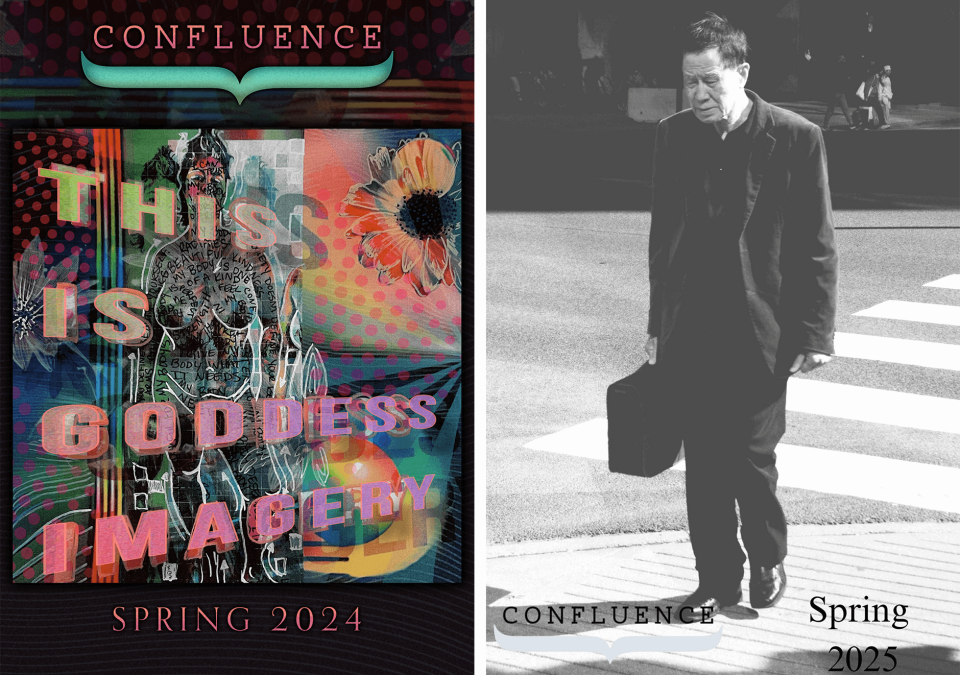
PFW writing students still wrestle with that question today, and one way to learn the answer is by publishing and seeing the reactions of others, which is why Confluence has been so important. PFW’s student-run literary magazine has been published since 1989, serving as a platform for learning writers to prove to themselves and others what they can do. Crisler contributed content before he graduated in 2004, and so did current Confluence advisor Sarah Sandman, now a professor of practice in English and linguistics.
Besides publishing her writing in the magazine, Sandman was also the editor in 2006 and 2007 as a graduate student. Now she’s the caretaker of the legacy, following the examples of her mentors, Rick Ramsey and Steve Amidon, who helped build her passion.
“I have a special investment because I came of age in my own love of literary magazines as the editor,” Sandman said. “I became very invested in keeping the tradition alive. To come back as advisor is a very full-circle kind of thing, and you don’t always get to do that in life.”
Sandman recently selected Belle Clark and Mia Faber as this year’s editors.
Since 2007, Confluence has been an online magazine, though there’s an option to purchase a print-on-demand version, usually by the writers or their family members who want a hard copy and keepsake to show others.
Online or printed, the thrill of having a work selected for the magazine by the student editorial board is still special, especially if it is the first time an author has been published.
“It was very nerve-wracking because it’s hard to put a piece of yourself out there, especially one that is targeted by people,” said PFW grad student Truitt Taylor, B.A. ’25. “I would always say I was a writer, but I had never had anything published before.”
Truitt published “The Hum of the Chevy” in last spring’s edition, a story of telling her younger brother about her decision to transition to female. The brother was wearing headphones, though the assumed one-way discussion contains a surprise. Truitt said she “shot-gunned” the story over three nights to make the submission deadline and get it out of her head and onto paper.
Because she preordered a printed copy, Truitt’s family loved seeing her story in print. She quickly opened the book upon receipt to first see who else had their work included, and then turned to her own story.
Clark, now a senior majoring in English with a concentration in writing, was one of those authors last year. At first, she was excited because two of her professors were offering extra credit to students who submitted to the magazine, but seeing her stories “New York City is Full of Artists, and I” and “My Dad is an Artist, and” took her energy to a new level with her first published pieces.
“Seeing that they thought my stories were worth putting in the journal was exciting,” Clark said. “It’s also been helpful because it’s shown me that there’s always room to push it further. I have always felt the need to write, and I think I’m learning that I can transition from writing for myself to also writing for others. Can I write stories that maybe heal a part of me, but also stories that are maybe going to heal a part in somebody else?”
Her poignant story “My Dad is an Artist, and” is about something she learned about her father later in life, which deeply affected her. Like Taylor’s effort, Clark’s writing showed courage to share such a personal tale.
And that is what Confluence does best, offering the opportunity for writers to share their best, earn a bit of legitimacy, and learn more about themselves. It’s a chance to look ahead, but also inward where the best writing comes from.
As Clark said, “Sometimes it’s just a really great way to understand the world around you and understand what is happening inside of you. I’m really glad that PFW has that opportunity for creatives and students in general to share their voice, get to share their art, and just express who they are. It’s exciting to be part of that.”
Submissions of writing, art, and photography for the 2026 edition of Confluence will be open until the start of April. Original works and questions can be emailed to [email protected].
Related Articles
Administration, Arts and Humanities
Purdue Fort Wayne opens the Surack-Sweetwater Music Industry Center
Arts and Humanities, Business and Innovation
Four Purdue Fort Wayne faculty members named finalists for Best College Professor in Readers’ Choice Awards
Arts and Humanities, Education, Science
CELT Teaching Award winners announced

Administration, Arts and Humanities, Athletics, Business and Innovation, Education, Engineering and Technology, Social Science
Purdue Fort Wayne to celebrate nearly 1,300 graduates during commencement week