PFW/FWCS collaborate to support students through new mental health program
By Blake Sebring
March 17, 2026
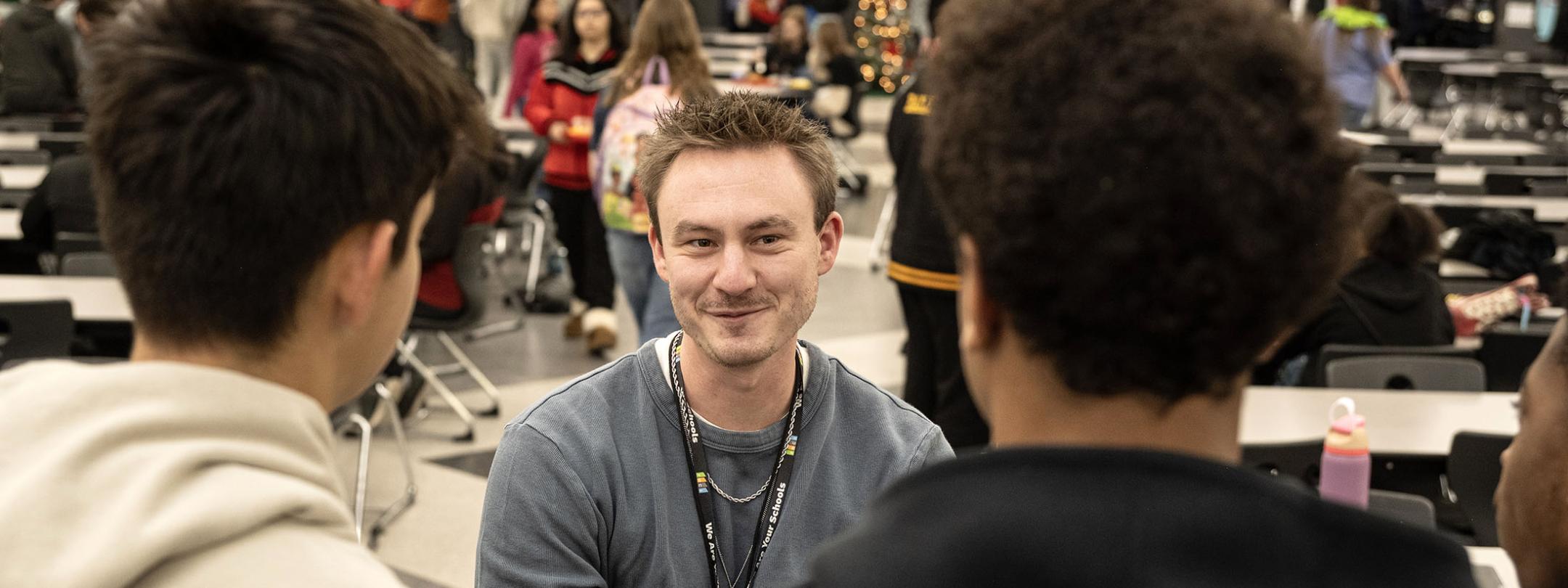
Every day, Trevor Helmkamp gets to live his dream of making a positive impact on high school students. The third-year Purdue University Fort Wayne graduate student is serving a year-long internship at Snider High School as a guidance counselor, helping students deal with mental health issues.
“I could have walked in here and been like, `I don’t know what I’m doing,’ but I was well-prepared,” Helmkamp said. “PFW’s influence on what I do here and how I’m using my education is instrumental to even be able to do a position like this.”
Helmkamp is part of PFW’s partnership with Fort Wayne Community Schools to provide graduate students across the district through a five-year U.S. Department of Education grant the corporation received. According to Brooke Sellhorn, clinical director of the Department of Counseling and Graduate Education, PFW has provided the program with 29 paid interns over the first three years. Many have been later hired for full-time positions.
“The success of this program is rooted in ongoing collaboration,” said Toni Harmon, a FWCS supervisor and graduate of PFW’s counseling program. “FWCS and PFW worked together to establish clear structures for supervision, communication, and role coordination between graduate students functioning in the mental health counselor role and current school counselors.
“Because this program was built collaboratively, PFW interns are not simply added into schools—they are integrated into existing support systems. This has made it possible to sustain the program while meeting real and growing mental health needs among students.”
Harmon and fellow PFW program product Regan Fry supervise the enterprise, initiated as part of a 2023 grant to provide mental health support in 16 middle and high schools. The previous FWCS ratio of mental-health providers was 1 for every 2,933 students before the program started, and it is expected to reduce to 1 for every 244 students, according to The Journal Gazette.
Helmkamp said he regularly works with more than 10 students, adding that he could see a student every period of the day if he wasn’t splitting his time.
Following their first year in the classroom, PFW graduate students spend their second year working in the on-campus Community Counseling Center, which helps prepare them as much as possible for their third-year internships.
“Students are what we call dual-track so they are eligible to be licensed as a school counselor or a mental health counselor, so this internship is perfect for those that want to do both,” Sellhorn said. “There’s a shift toward more mental health counseling in schools, so our students have been part of that transition of being able to work in either capacity. This has been very affirming to our students.”
Along with program faculty, those graduate students are often supervised and mentored by previous PFW program graduates, including Fry and Harmon.
“The problem is that the mental health needs have gotten to be so great that it’s overwhelming for everybody in the school to know how to handle it,” said Joel Givens, associate professor of counselor education. “Our students have really been able to provide positive help and results.”
Officials from both PFW and FWCS hope the positive results and collected data will lead to more grant money and resources so the program can continue when the current grant ends.
“It’s very hard to find paid internships,” said PFW’s Kerrie Fineran, PFW chief of Campus and Community Wellbeing. “They are responding to so much that students are bringing to school, and now they have someplace and someone to look to for help. Many of them have nowhere else to receive it.
“It’s really a great opportunity for our students to get this level of training and support. We continue to have regular meetings with FWCS to study how we can improve this partnership and build a template that might end up affecting hundreds of schools. This is how the system is supposed to work.”
This is how schools are supposed to help students.
“To see kids walking into my office crying and then leaving with a smile on their faces just makes my day,” Helmkamp said. “It kind of shocks me to my core that I’m able to have that sort of impact.”
Related Articles
Education, Engineering and Technology, Science
Girl Scouts STEM Expo sparks curiosity, confidence, and career dreams at PFW
Education
PFW School of Education earns A+ national rating and national accreditation for excellence in teacher preparation
Education
Purdue University Fort Wayne class lets students explore teaching as a career
Arts and Humanities, Education, Science
CELT Teaching Award winners announced