PFW Story
Mathematical Sciences instructor and partner make strong point in acclaimed research journal
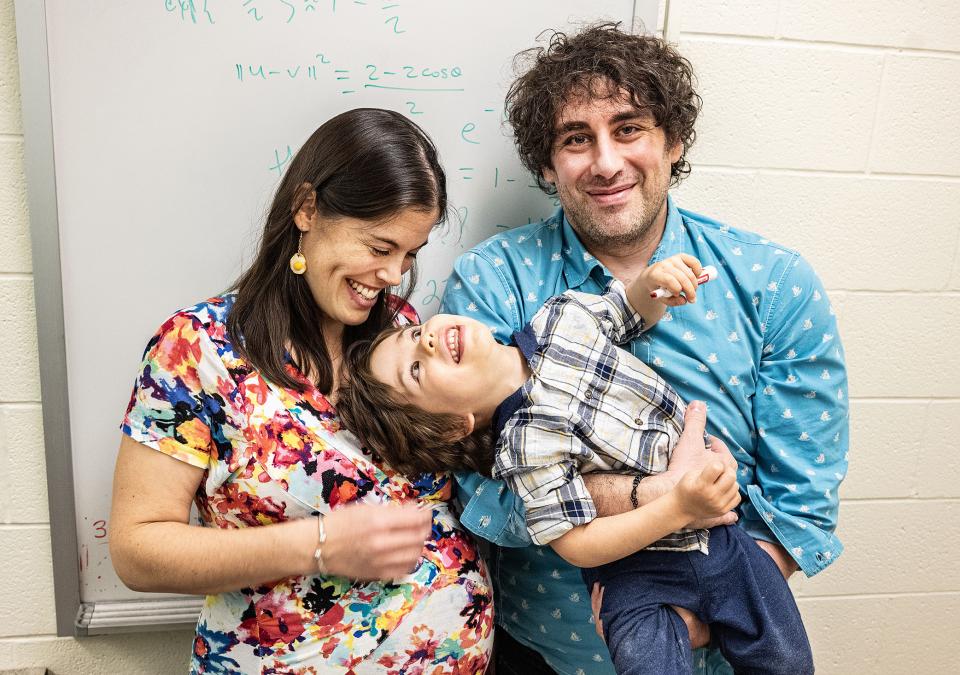
When two-year-old Nunzio Stanley Selvitella visits his father’s office in the Purdue University Fort Wayne Department of Mathematical Sciences, he loves to draw doodles and express his ideas with loops and lines on the whiteboard.
His parents like to make their marks in major scientific journals.
Alessandro Selvitella, assistant professor of data science and applied statistics, and his partner, Kathleen Foster, assistant professor of biology at Ball State University, recently had a unique idea published in the Oct. 2 print edition of Nature, a weekly international journal devoted to the finest peer-reviewed research in all fields of science and technology.
Under the headline, “AI tools could reduce the appeal of predatory journals,” Selvitella and Foster discuss how the use of artificial intelligence—often debated as potentially anathema to academic research and publication—can provide an unexplored positive influence.
“Authors sometimes turn to predatory journals when they need rapid publications, for example, or after repeated rejections from reputable venues. AI can help to level the playing field by equipping researchers who are early in their careers or those not writing in their first language to produce submissions suitable for recognized scholarly outlets.”
AI, the authors argue, can provide pre-submission review and rapid feedback, allowing authors to quickly revise and polish their work. They propose that AI-assisted writing—when used and disclosed responsibly—could support researchers and make the academic record more reliable.
Selvitella was born in Garbagnate Milanese and raised in Cesate, two small Italian cities near Milan. He arrived at PFW in 2019 after meeting Foster in Canada in 2018. He has published more than 60 articles, including approximately 20 with Foster.
“For example, people who don’t speak or write English well might write documents that do not meet journals’ English clarity criteria,” Selvitella said. “You want to have a paper that is as good as possible, and sometimes as a young researcher especially, you may be worried or tentative, and you might end up submitting things to predatory journals because they have a high acceptance rate.
“To find a job, young mathematicians need to publish. Now English-disadvantaged communicators can use AI to help with that, and maybe they can submit their work to a better journal because now it is of better quality.”
Calling AI a democratizing tool, Selvitella said it can help mitigate problems for those being disadvantaged for unfortunate reasons. As he said, every major scientific journal uses English.
“I think our observation was a timely and new perspective to the scientific audience,” Selvitella said. “We thought it was relevant because it is complementary to the concerns of the use of AI support in current research. We are not aware of other publications on the same idea.”
Selvitella and Foster are currently working on a four-year National Science Foundation grant titled, “The mathematical laws of morphology and biomechanics through ontogeny.”
Related Articles
Education, Engineering and Technology, Science
Girl Scouts STEM Expo sparks curiosity, confidence, and career dreams at PFW
Science
From volunteer to researcher: PFW graduate student helps restore rare Franklin’s ground squirrels
Science
Inside the Fort Wayne Zoo: PFW Students Gain Hands-On Experience
Arts and Humanities, Education, Science
CELT Teaching Award winners announced